
The Data Gap in Data Careers: Co-Creating the 2026 Future-Fit Report
For years, the dominant career advice has been a simple refrain: learn AI. For professionals building and maintaining the systems behind this transformation, such as data scientists, ML engineers, and data analysts, this advice is insufficient and misleading. We are witnessing a fundamental restructuring of job architectures. The neat, siloed roles of the past decade are dissolving 1, 2. Data science responsibilities are meshing with ML engineering 3. Data analysts are evolving into analytics engineers who build data products 4. Engineering roles must now account for product knowledge, cost management, and governance 5. Compounding this is a relentless flood of new tools. For practitioners, this creates a paralyzing decision friction, a lack of critical intelligence on what is actually in demand in production environments versus what is merely hype 6. The challenge is not to learn AI, but to upskill strategically 7. Yet in an information vacuum, knowing where to focus becomes a guessing game.
To stay competitive, we need to move beyond generic encouragement. We need to identify the specific fusion points where roles are overlapping, understand what the job market demands today versus a few years ago, and separate signal from noise 8, 9. In the following sections, we will discuss these evolving role intersections and data signals. More importantly, we will outline how we plan on solving this to help people navigate their careers in AI and data.
The Convergence of Roles
What we’re witnessing is not merely an expansion of job descriptions but a fundamental merging of functions that were once more separated 2. The specialization that defined data and AI teams for the past decade, data analyst, data scientist, ML engineer, data engineer, is giving way to hybrid roles that straddle previously distinct domains. In this section, we will dive into concrete examples of these fusion points in different AI and data roles and discuss how critical scaling pressures are occurring.
Examples of Role Fusion
Data Scientist + ML Engineer Fusion
The boundaries between data science and ML engineering are dissolving. Data scientists who cannot deploy their own models are becoming a liability. ML engineers who lack modeling intuition cannot optimize effectively. As the arXiv paper “The AI Roles Continuum” notes, the distinction between research and engineering is blurring as organizations demand end-to-end ownership 3. This is giving rise to the applied data scientist or ML engineer with modeling depth, professionals who move fluidly from experimentation to production. Staying competitive in this environment means shifting your upskilling strategy towards focusing on end-to-end ownership that bridges the gap between theoretical modeling and engineering execution.
Data Analyst + Analytics Engineer Evolution
The traditional data analyst focused on static dashboards and ad hoc SQL queries. This is evolving into the analytics engineer. This new role combines business acumen with data modeling, engineering discipline, and a product mindset. As Acceldata observes, AI is driving a “convergence of personas” across functions 2. Analysts now build “curated data products”: reusable, governed datasets that serve both human decision-makers and automated AI agents 4. In this environment, to upskill, data analysts need to master data architecture, treat data as a managed product, ensure rigorous governance and quality, and serve as the strategic translators between complex technical logic and business narratives 4.
Data Engineer + ML Engineer Overlap
Data engineers are no longer simply building ETL pipelines; they are architecting the infrastructure that enables AI systems to function reliably at scale, feature stores, data versioning, and governance frameworks 5. Meanwhile, ML engineers are absorbing responsibilities once belonging to data engineers. As Coalesce puts it, AI will not replace data engineers but will “bury them under a mountain of chaos” unless they evolve 5. The engineers who thrive will be those who bridge data infrastructure and model operations. In this new environment, data engineers need to upskill by transitioning from manual pipeline builders to strategic architects who master AI-assisted automation, prioritize rigorous data governance, and design self-healing infrastructures that ensure data is both machine-readable and trustworthy 5.
The Rise of the AI Product Manager
The AI product manager manages probabilistic systems that change over time, models that drift, behave unexpectedly, and require constant calibration 7. This role demands fluency in technical constraints (latency, cost, accuracy trade-offs) and human factors (user trust, explainability, ethical risk) 7. It bridges what is technically possible with what is organizationally viable. Because these systems are not static and evolve over time, traditional product management frameworks are insufficient. AI PMs must have a deep comfort with experimentation, uncertainty, and ethical considerations 7. The role also requires a blend of technical skills alongside strategic thinking 7. The expectation for technical fluency is becoming so pronounced that the boundary separating product managers from software developers is dissolving 16. To thrive in the evolving landscape, AI Product Managers need to upskill by transitioning from traditional feature managers to strategic AI orchestrators who master technical model intuition, lead on AI ethics and governance, and treat curated data as the foundational core of the product lifecycle 7, 16.
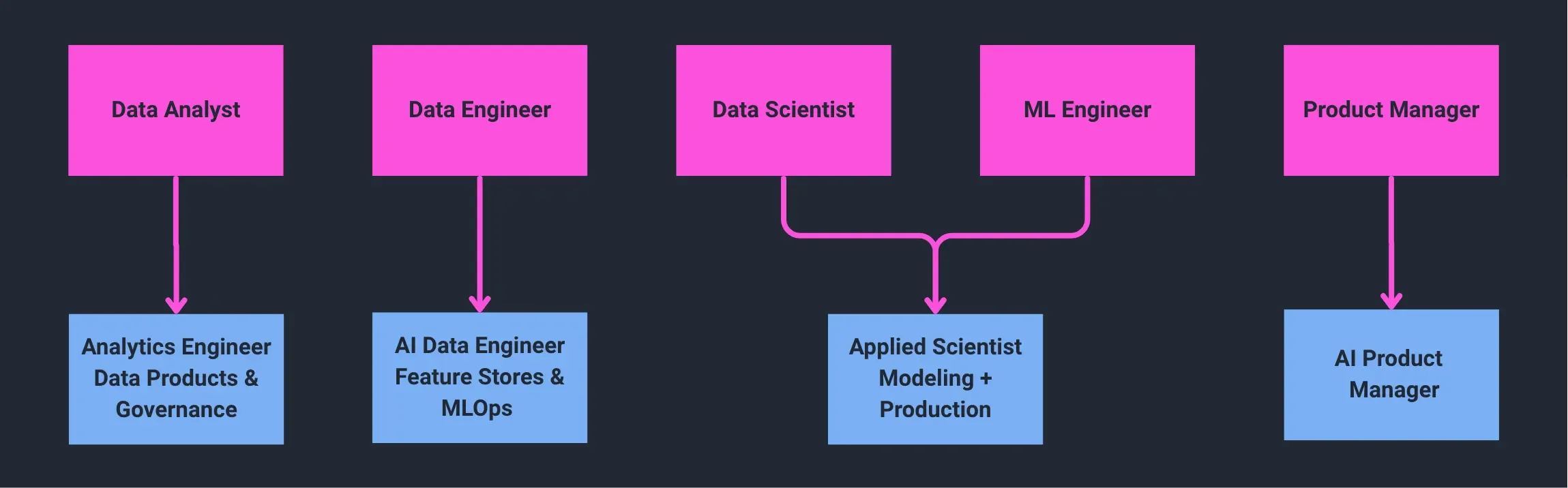
Traditional siloed roles (pink) are converging into hybrid functions (blue) as AI reshapes job architectures. Data analysts evolve into analytics engineers. Data engineers become AI data engineers. Data scientists and ML engineers merge into applied scientists. Product managers become AI product managers.
Vertical Scaling Pressures
Beneath these role fusions lies a deeper dynamic: the vertical scaling of responsibility. As AI systems move from experimental proof-of-concept to production-critical infrastructure, professionals at every level are being asked to own outcomes, not just tasks. This manifests in several ways:
Cost Accountability: Understanding inference economics and the relationship between model choice and operational cost 5.
Product Ownership: Understanding how a model creates value and what failure looks like to users 7.
Governance Responsibility: Understanding bias, explainability, and regulatory compliance, domains once left to legal or ethics teams 5.
Continuous Adaptation: Continuously recalibrating what constitutes fundamental knowledge in their domain 10.
These vertical pressures, cost, product, governance, and adaptation are the hidden forces driving role fusion. They are why a data scientist must now understand deployment costs, why a data engineer must think about model governance, and why every role is absorbing responsibilities that once belonged to someone else.
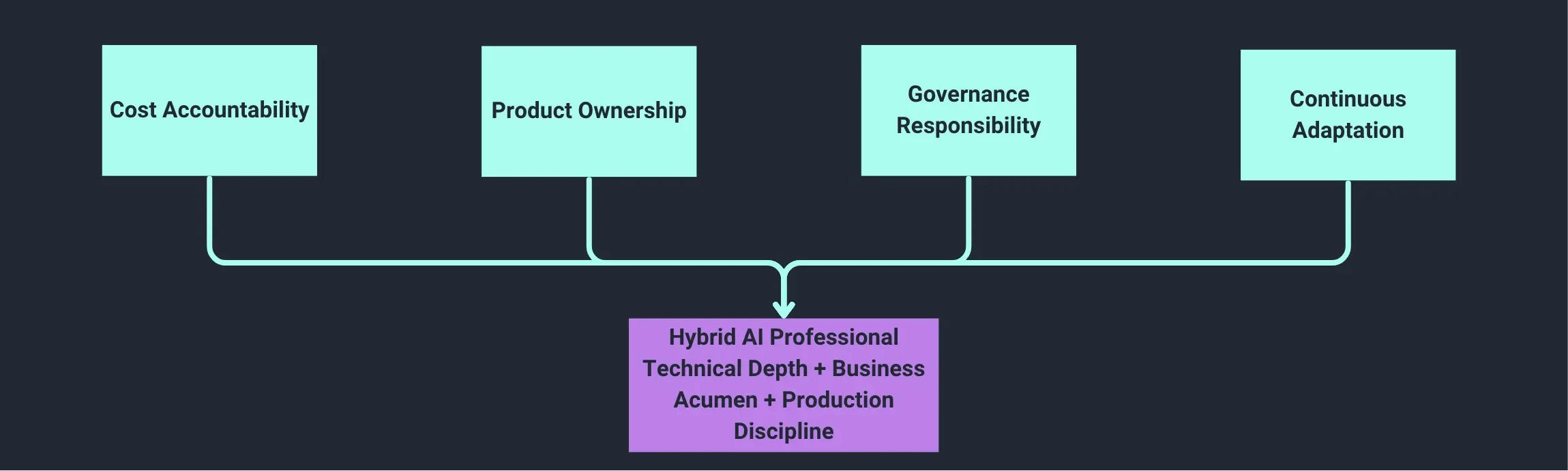
Four vertical pressures, cost accountability, product ownership, governance responsibility, and continuous adaptation , converge on the hybrid AI professional, reflecting the expanded scope of modern data and AI roles.
Signal vs Noise
If role fusion represents the structural reality of today’s AI job market, the challenge of separating signal from noise represents its psychological core. Practitioners are drowning in information but starved for insight.
Decision Friction Crisis
The velocity of new tools, frameworks, and models has created a decision friction crisis. A new model or a tool is announced weekly. Best practices shift before they can be documented. For professionals trying to build coherent skill sets, the result is paralysis. As McKinsey notes, the gap between experimentation and scaled implementation remains vast 11. What generates excitement in research may be entirely impractical for production systems that demand reliability and cost predictability.
Beware not to fall into the AI Tool Trap because “new AI tools and terminology [are] appearing almost daily, it’s tempting to try to keep up with everything,” but this instinct to chase every new feature “can fast-track burnout” 18. Burnout risk is rising, particularly among younger workers, who report higher levels of stress and emotional exhaustion 18. One in five professionals is experiencing burnout symptoms, which manifest as “cognitive and emotional impairment, exhaustion, and mental distance” 18. The psychological toll this exciting time leads to is anxiety about falling behind, fear of backing the wrong stack, and confusion about what is foundational versus ephemeral.
Stakeholder Hype
A significant source of noise is the disconnect between stakeholder enthusiasm and production realities. Executives, driven by fear of missing the AI wave, often push for whatever technology is currently capturing headlines. Business teams frequently launch AI initiatives based on hype with zero regard for governance or cost, resulting in 88% of AI proofs-of-concept failing to reach widescale deployment 5, 12. But as PwC documents, organizations seeing real returns focus on disciplined implementation, not headline-chasing 13. The value gap is stark: technologies that excite boardrooms often fail in production because infrastructure, talent, and operational discipline are underestimated. The signal lies in understanding what is actually demanded in production, reliable data pipelines, MLOps maturity, cost management, and governance. The noise is the endless parade of models that solve benchmarks but ignore operational reality.
The Gendered Signal Gap
Compounding these challenges is a gendered dynamic. While recent labor market data from Anthropic reveals that women are 16 percentage points more likely than men to work in roles highly exposed to AI displacement 17, their willingness to adapt is evident. Tracking by Deloitte shows that women’s adoption of generative AI has grown at triple the speed of men’s, putting them on a trajectory to reach parity 14.
However, navigating this transition is hindered by a persistent “technology trust gap” and a lack of systemic support. Only 18% of female adopters have high trust that AI providers will keep their data secure, compared to 31% of male adopters 14. Furthermore, female AI users overall report receiving significantly lower levels of employer encouragement (61% vs. 83% for men) and training support (49% vs. 79%) 14. Without this organizational guidance, filtering industry noise to find reliable signals becomes incredibly difficult.
Interestingly, women already working within the tech sector face fewer of these barriers; they receive ample training and are actually moving past experimentation into practical AI application faster than their male counterparts 14. Yet, despite these strides by users and tech professionals, a severe representation crisis remains at the foundational level: women comprise only about 30% of the core AI workforce 14, 15. This underrepresentation represents both an equity concern and a competitive risk, as homogeneous teams are more likely to create narrow or biased technology 14, 15. Ultimately, the gendered signal gap is not a lack of willingness to adapt. It is the reality of having to adapt in a rapidly changing environment with less trust, less organizational support, and fewer voices shaping the tools themselves.
The Qualification Trap
The most insidious consequence of the noise is the qualification trap. Because the skills required for AI-exposed jobs are changing 66% faster than other roles, professionals feel intense pressure to constantly accumulate credentials without a clear framework for prioritization 19.
While accumulating certifications creates a baseline of knowledge, it is insufficient on its own 7. To escape the qualification trap, professionals must recognize that employers are shifting their focus away from pure programming speed and toward roles that demand both “code and context” 20. The future belongs to those who can pair deep AI capabilities with the strengths machines cannot easily replicate, such as adaptability, innovative thinking, clear writing, and conflict mitigation 1, 20.
Ultimately, employers are demanding proof of practical ability and resilience under real-world conditions. Professionals should adopt a “fail-fast” prototyping mindset by building personal projects that solve actual business problems 7. As the industry consensus notes, “a certification might get you an interview, but a portfolio demonstrating real-world impact is what gets you the job” 7.
The Competitive Risk
The stakes extend beyond individual careers. Organizations that cannot help talent navigate this landscape face real competitive risk. Teams that chase hype waste resources on technologies that never reach production. Professionals who burn out trying to learn everything produce less. Both PwC and McKinsey emphasize that the organizations pulling ahead (AI high performers) are those that take a systematic approach. Rather than chasing experimental hype, these organizations focus on redesigning workflows, establishing robust talent architectures, and enforcing clear governance 13, 11. The future belongs to professionals and organizations that strategically bridge technical skills with business acumen, focusing on production-ready execution and operational intelligence over superficial tool-chasing 7. For individuals, the ability to filter noise and identifying signals is becoming the defining competency of the AI professional.
Bridging the Gap: From Consumer to Contributor
The challenges outlined here share a common root: practitioners are operating as consumers of AI news rather than contributors to collective intelligence. We chase headlines alone, and insights remain siloed.
To move beyond this, we need structured, community-generated intelligence that maps where the field is actually going. That’s why we launched the Collective Insight and Strategy Survey. It captures real-time data on which skills are essential, which tools survive production, and where role fusions are forming. Every response helps build a clearer signal in a sea of noise.
W2D2 IWD Career Summit 2026: Break the Pattern
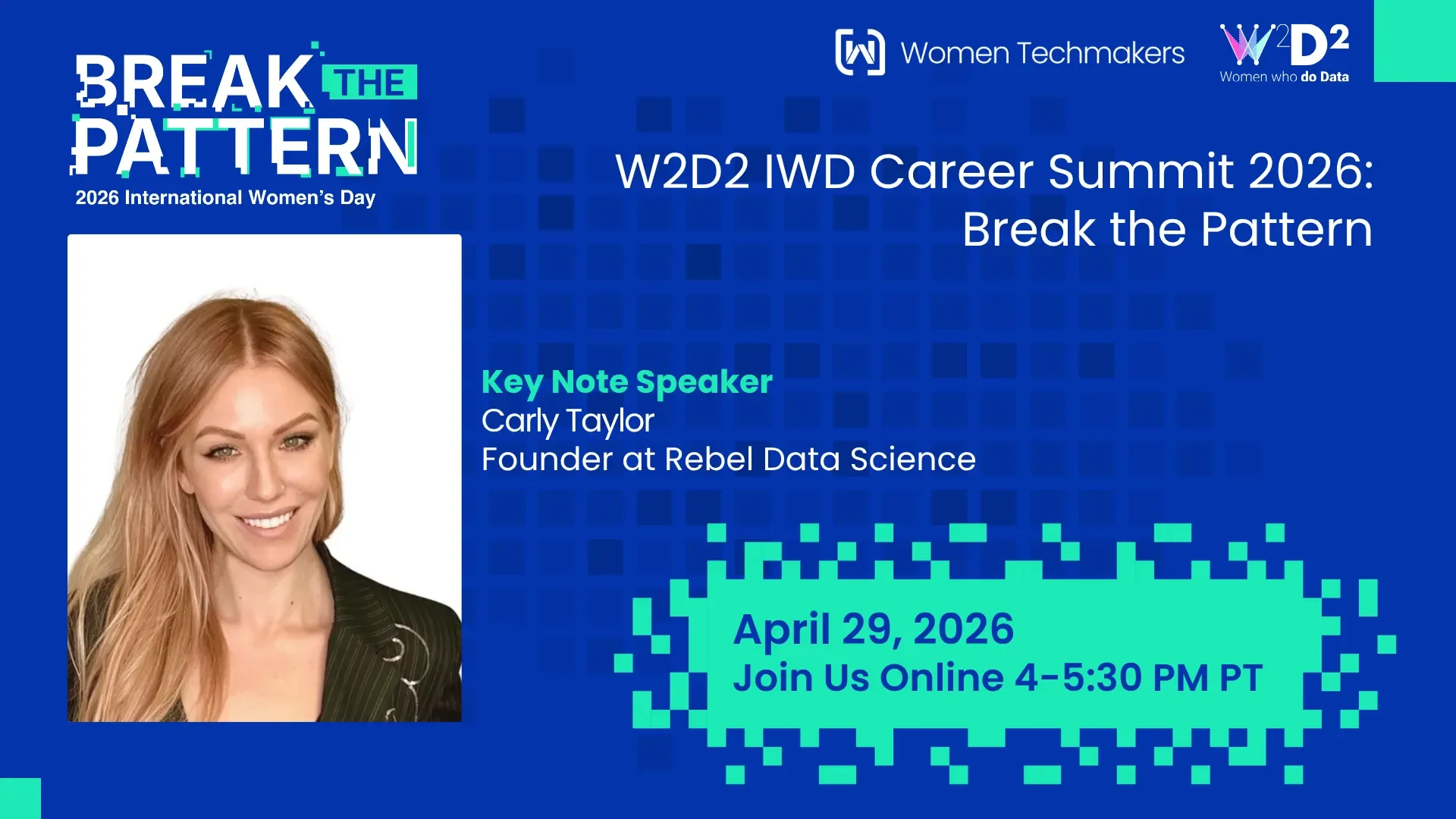
This International Women’s Day, we’re moving beyond celebration to action. Join us on April 29, 4 PM PT for the W2D2 IWD Career Summit 2026: Break the Pattern, an immersive event where practitioners generate community intelligence instead of passively consuming AI news.
Keynote by Carly Taylor, Founder of Rebel Data Science and ML engineer with multiple patents, will share battle-tested strategies for staying competitive. Participants will then join a live skills and tools mapping forum and work with mentors to build a customized action plan.
Registration for the event is now open here.
Conclusion: Design Your Future
The professionals who thrive in this shifting landscape will not be those who passively consume the loudest signals. They will be those who contribute to collective intelligence, who help map the fusion points and distinguish signal from noise.
That’s the invitation. Contribute your signal. Help us map the fusion. Take the Collective Insight and Strategy Survey and join us at the W2D2 IWD Career Summit to help build the 2026 Community Intelligence Report.
References
Convergence of Personas: How AI is Reshaping Data Management Functions
The AI Roles Continuum: Blurring the Boundary Between Research and Engineering
Why the Data Analyst’s Evolution is Key to AI-Ready Enterprises
Data and AI Jobs for Tomorrow: What Stays, What Fades, What Evolves
The state of AI in 2025: Agents, innovation, and transformation
Understanding Inference Economics and Why AI Costs Spiral Beyond Proof of Concept
Women and generative AI: The adoption gap is closing fast, but a trust gap persists
Women in AI: Key Statistics Revealing the Gender Gap in Tech
How AI is reshaping SaaS competition — companies need to adapt
Labor market impacts of AI: A new measure and early evidence
The Human Skills You’ll Need to Thrive in 2026’s AI-Driven Workplace
Read on Medium.